THE MYTH
« FONAREV is a reparations fund for victims »
Source: financial investigation reports 2024–2025
THE EVIDENCE
FONAREV — the Fonds National des Réparations des Victimes — was established by Congolese law on December 26, 2022 with an explicit mission: identify victims of violence, provide psychosocial support, accompany them through legal processes, and deliver financial reparations. This mandate was legitimate and long-awaited.
The reality of how FONAREV operates is the opposite of its mandate. Between January 2024 and June 2025, FONAREV raised over $212 million from the Congolese government, international donors, and philanthropic organisations worldwide. Of that amount, less than 2.5% — roughly $5 million — reached beneficiaries. And even then: those $5 million were not used for direct victim support. They funded the renovation of a school and the construction of a memorial in Kisangani, Tshopo Province.
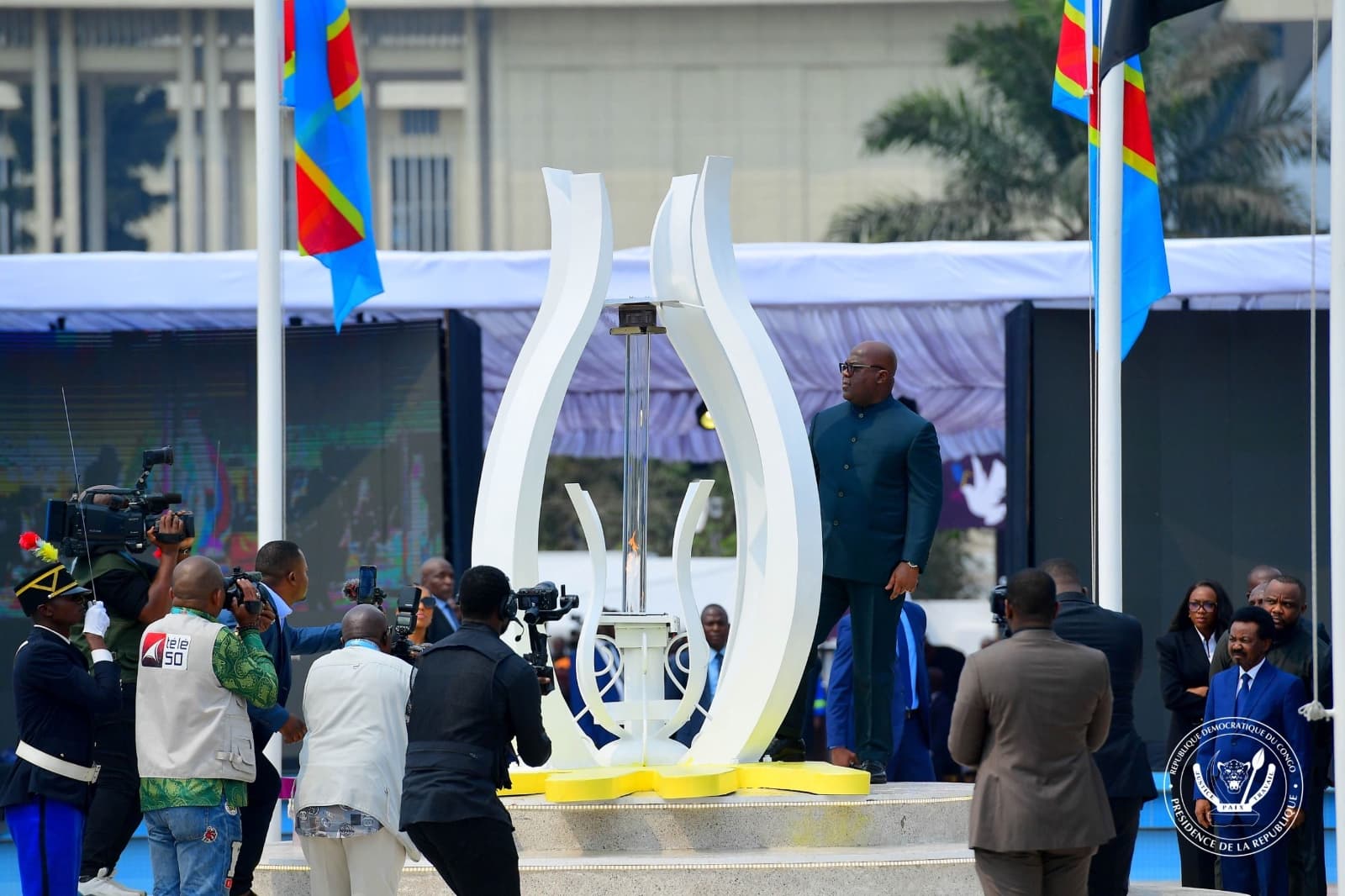
The remaining $207 million was redirected toward prestige memorials, luxury concert productions, international travel, digital propaganda campaigns, and, according to financial investigators, private accounts connected to President Tshisekedi's family and political inner circle. The 2025 Genocost commemoration event alone allegedly cost over $1.6 million — a single ceremony, for an institution that cannot find money to pay survivors.
This is not a rounding error. This is not bureaucratic inefficiency. An institution founded in the name of genocide victims — funded by international donors who believed they were helping those victims — distributed less than three cents of every dollar collected to the people it was created to serve. Congolese survivors are not FONAREV's beneficiaries. They are its props.
Sources
- —Rapports d'enquête financière 2024–2025
- —Jeune Afrique, dossier FONAREV 2025
- —Loi RDC 22/065 du 26 décembre 2022
- —Justice Info, financement FONAREV
THE MYTH
« "The Tutsi" constitute a collectively guilty group for genocide »
Source: FONAREV, official website (fonarev.cd)
THE EVIDENCE
FONAREV's official website — a state institution funded by public money and international donors — stated: 'The systematic and planned massacres of Bantus of the DRC by Tutsis from Rwanda, Uganda and Burundi constitute a genocide that must be recognised as such.' [Archived version, as the page has since been edited: https://web.archive.org/web/20250219114341/https://www.fonarev.cd/a-propos-du-fonarev] This sentence deserves to be examined word by word.
The invocation of 'Bantu' as the victim category is not an ethnic descriptor. It is a political mobilisation device. 'Bantu' covers hundreds of ethnic groups across Central and Southern Africa — it is a linguistic and anthropological classification, not a political community. Using it as the named victim population implies a coherent, unified people under attack. It does not describe reality; it manufactures a constituency.
More critically: the framing of Bantu-versus-non-Bantu maps directly onto the anti-Tutsi ideology that powered the 1994 Genocide against the Tutsi in Rwanda — in which Tutsi were framed as alien non-Bantu interlopers who did not belong in Central Africa and whose elimination was a matter of self-defence for the 'authentic' population. FONAREV has taken that exact ideological structure and inverted it for domestic political use. The architecture is identical. The consequences of such language in conflict zones are well-documented.
'Tutsi from Rwanda, Uganda and Burundi' are not a state, an army, a government, or an organised political body. They are millions of civilians — farmers, teachers, traders, refugees, students — who happen to share an ethnic identity. Attributing collective guilt for specific armed actors to an entire ethnic group is not political advocacy. It is ethnic incitement. FONAREV is a state institution, funded by public money, with an annual commemoration drawing hundreds of thousands of people. When that institution writes 'Tutsi' as the named perpetrators of genocide, it is not expressing the grief of survivors. It is encoding ethnic hatred into the apparatus of the state.
Sources
- —FONAREV, site officiel (fonarev.cd)
- —Genocide Watch, rapport Afrique centrale 2024
- —Convention pour la prévention du génocide, ONU, 1948
- —TPIR, Affaire Akayesu — définition de l'incitation au génocide, 1998
THE MYTH
« A genocide must be recognised by the international community »
Source: ICC, DRC situation (opened 2004); UN Mapping Report 2010
THE EVIDENCE
The International Criminal Court has been investigating crimes committed in the Democratic Republic of Congo since 2004 — over two decades, covering exactly the period FONAREV's founding documents cite as their historical basis. In those twenty-plus years of investigation, the ICC has not issued a genocide determination for the Congolese conflict.
Genocide has a precise legal definition under the 1948 UN Convention: acts committed 'with intent to destroy, in whole or in part, a national, ethnical, racial or religious group, as such.' This specific intent — dolus specialis — must be proven independently of proving that killings occurred. Mass killing alone, however grave, does not constitute genocide in law.
The UN Fact-Finding Mission concluded in 2025 that multiple parties to the DRC conflict — including not only M23 but also FARDC and Wazalendo militias — committed acts that may constitute war crimes and crimes against humanity. These are grave designations. But they are legally distinct from genocide, and that distinction exists for a reason.
FONAREV did not arrive at the genocide determination through legal process, evidence, or international adjudication. It arrived at it politically — because 'genocide' is the word with the most moral weight, the most international recognition, and the most power to delegitimise an adversary. Calling something genocide without meeting the legal standard for genocide is not advocacy. It is instrumentalisation of one of humanity's gravest concepts for domestic political gain.
Sources
- —CPI, situation en RDC, dossier ouvert en 2004
- —Mission d'établissement des faits ONU, rapport 2025
- —Rapport Mapping ONU, 2010
- —Convention pour la prévention du génocide, ONU, 1948 — Article II
THE MYTH
« The GENOCOST narrative presents a complete picture of the conflict »
Source: UN Group of Experts Reports on DRC 2023–2025; UNSC Resolution 1804
THE EVIDENCE
The Forces Démocratiques de Libération du Rwanda (FDLR) are a terrorist organisation designated by the US State Department, whose founding leadership included architects of the 1994 Genocide against the Tutsi in Rwanda. After that genocide, génocidaire forces and roughly one million Hutu refugees fled into eastern Zaire. The FDLR has operated from that Congolese territory for over 30 years, preying on civilian populations of all ethnicities, including Congolese Tutsi (Banyamulenge).
The UN Security Council has passed over 12 resolutions recognising the FDLR as a central actor in the conflict and demanding their disarmament. UN Panel of Experts have repeatedly documented elements of DRC's armed forces (FARDC) operating in tactical coordination with FDLR units. These reports, submitted to the Security Council, are public record. To date, DRC has never fully enforced any FDLR disarmament mandate.
The Banyamulenge — Congolese Tutsi of Congolese citizenship — are erased as victims in the Genocost framework. Hundreds of thousands live as stateless refugees in Uganda, Rwanda, and Burundi, expelled from a country that claims them as citizens. Wazalendo militias, fighting under the banner of the Congolese government, have targeted Tutsi civilian communities during armed operations. None of this appears in the Genocost framework, because acknowledging Congolese Tutsi as victims of Congolese state-aligned forces breaks the clean Bantu-victim / Tutsi-perpetrator binary the campaign requires.
Any analysis of the eastern Congo conflict that does not account for the FDLR, Congolese governance failures, and the multi-actor nature of atrocities is structurally incomplete. FONAREV's omission is not an oversight. It is an editorial decision that serves a predetermined political conclusion.
Sources
- —Rapports du Panel d'experts ONU sur la RDC, 2023, 2024, 2025
- —CSNU Résolution 1804 (2008) — dissolution des FDLR
- —CSNU Résolution 2360 (2017)
- —US Department of State, FDLR Terrorist Designation
- —Human Rights Watch, Banyamulenge displacement reports
THE MYTH
« Millions of deaths automatically constitute genocide »
Source: UN Convention on the Prevention of Genocide, 1948, Art. II
THE EVIDENCE
The gravity of a crime does not automatically qualify it as genocide. The 1948 UN Convention requires proof of specific intent to destroy a protected group — dolus specialis. These crimes are crimes against humanity: equally grave, equally prosecutable today.
THE MYTH
« Supporting an armed group is legally equivalent to committing genocide »
Source: ICC, jurisprudence on genocide complicity; UN Panel of Experts, 2023–2025 reports
THE EVIDENCE
Supporting an armed group and committing genocide are two legally distinct things. No international court has established this equivalence for the Congolese conflict. The FDLR — present in the DRC for over 30 years, with a founding leadership implicated in the 1994 genocide against the Tutsi — constitute, for their part, a documented case systematically ignored by the official narrative.
THE MYTH
« Criticising FONAREV is tantamount to opposing reparations for victims »
Source: CAYP, public statement, June 2026
THE EVIDENCE
It's the opposite. CAYP itself — founders of the term 'genocost' — denounced FONAREV as a 'farce'. Criticising a fund that retains 97.5% of the money collected is defending the victims. Silently approving it is betraying them.
Dismantling the Genocost Myth: How FONAREV Weaponized Grief and Called It Justice
The Genocost campaign presents itself as a movement for truth, memory, and reparations. This dossier examines what it actually is: a state-manufactured narrative built on ethnic incitement, legal fiction, and the systematic looting of funds meant for the very victims it claims to champion.
I. What FONAREV Is — And What It Actually Does
FONAREV — the Fonds National des Réparations des Victimes — was established by Congolese law on December 26, 2022. Its stated mission is noble: identify victims of conflict-related violence, provide psychosocial support, accompany them through legal processes, and deliver financial reparations.
The reality of how FONAREV operates is the opposite of its mandate.
Between January 2024 and June 2025, FONAREV raised over USD $212 million from the Congolese government, international donors, and philanthropic organisations worldwide. Of that $212 million:
The Congolese survivors of eastern DRC's wars are not FONAREV's beneficiaries. They are its props.
What the numbers show
Less than 2.5% — roughly $5 million — reached beneficiaries in any form. That $5 million was not used for direct victim support. It funded the renovation of a school and the construction of a memorial in Kisangani, Tshopo Province.
The remaining funds — over $207 million — were redirected toward prestige memorials, luxury concert productions, international travel, digital propaganda campaigns and, according to financial investigators, private accounts connected to President Tshisekedi's family and political inner circle.
The 2025 Genocost commemoration event alone allegedly cost over $1.6 million — a single ceremony, for an institution that cannot find money to pay survivors.
This is not a rounding error. This is not bureaucratic inefficiency. An institution founded in the name of genocide victims — funded by international donors who believed they were helping those victims — distributed less than three cents of every dollar collected to the people it was created to serve.
II. The Term "Genocost" — Stolen from Civil Society, Handed to the State
The word 'Genocost' did not originate with the Tshisekedi government. It was first coined in London in 2013 by activists from the Congolese Action Youth Platform (CAYP) — a grassroots diaspora organisation trying to draw global attention to the economic dimensions of mass violence in eastern Congo. The concept was legitimate and important: that the mass killing of civilians in the DRC was not random warfare, but systematic destruction tied to the extraction of natural resources. Name it. Mourn it. Demand accountability.
The Tshisekedi government took that word, built a state institution around it, declared a national commemoration day, produced concerts and memorials, and recruited celebrities and artists to amplify it internationally. Civil society groups who created the term have said openly that the government's version 'feels unfinished' — an appropriation that takes what is politically useful and discards what is not.
What was discarded: the demand that all perpetrators be named, regardless of their relationship to Kinshasa. What was kept: the framing that designates a singular external enemy. The Genocost of the streets became the Genocost of the state — and in that transformation, it stopped being about victims and started being about power.
Context: the FDLR
Who are the FDLR?
The Forces Démocratiques de Libération du Rwanda (FDLR) are a US-designated terrorist organisation, whose founding leadership included architects of the 1994 Genocide against the Tutsi in Rwanda. After that genocide, these forces and roughly one million refugees fled into eastern Zaire. The FDLR has operated from that territory for over 30 years, targeting civilian populations of all backgrounds. FONAREV mentions them nowhere in its official documents.
Legal standards
Genocide — Article II, UN Convention 1948
"Acts committed with intent to destroy, in whole or in part, a national, ethnical, racial or religious group as such."
The intent requirement: dolus specialis
The specific intent to destroy a group must be proven beyond reasonable doubt — independently of proving that killings occurred. Mass killing alone does not constitute genocide in law. This threshold has never been established for eastern DRC in any international proceeding, including by the ICC which has been investigating there since 2004.
Crimes against humanity ≠ genocide
The UN Fact-Finding Mission (2025) documented acts that may constitute war crimes and crimes against humanity in DRC — committed by multiple parties, including the FARDC and Wazalendo militias. These are grave findings. But these crimes do not require the intent to destroy a group. They are legally distinct categories. Conflating them distorts the law and undermines legitimate accountability efforts.
Full timeline
1994 Genocide against the Tutsi in Rwanda — over one million people in 100 days
The only legally established genocide in this region, recognised by the ICTR. Génocidaires and roughly one million Hutu refugees flee into eastern Zaire. They form the FDLR — the direct origin of the security crisis that follows.
Absent from GENOCOST narrativeFirst Congo War — génocidaire camps dismantled
Armed intervention dismantles génocidaire refugee camps in eastern Zaire. Mobutu's regime collapses. GENOCOST presents this as its starting point — without the 1994 context.
GENOCOST start date — cause omittedFall of Mobutu — Laurent-Désiré Kabila takes power
After 32 years of rule, Mobutu Sese Seko flees the country. Laurent-Désiré Kabila is brought to power with Rwandan and Ugandan support. Zaire becomes the Democratic Republic of Congo.
Second Congo War — Kabila rearms Hutu militias
Kabila expels foreign forces and rearms FDLR remnants. The war draws in six African nations. GENOCOST documents this period without mentioning the political decisions that triggered it.
Kabila assassinated — Joseph Kabila succeeds him
Laurent-Désiré Kabila is assassinated on January 16, 2001. His son Joseph Kabila succeeds him at age 29 and quickly opens peace negotiations with neighbouring countries.
Pretoria Agreement — FDLR disarmament mandated, not implemented
Formal peace is signed. FDLR disarmament is mandated. DRC does not enforce it — and never fully does to this day. This failure is central to understanding every subsequent episode of violence.
Violence resumes in Kivu — FDLR still present
Violence resumes in North and South Kivu provinces despite the peace agreement. The FDLR, whose disarmament was never enforced, continue operating from eastern Congo's forests.
UNSC Resolution 1804 — immediate FDLR dissolution demanded
The UN Security Council adopts Resolution 1804 demanding the immediate dissolution of the FDLR. This is one of 12+ resolutions recognising the FDLR as a central actor in the conflict. DRC still does not enforce it.
GENOCOST does not mention FDLR resolutionsUN Mapping Report — serious crimes documented, genocide not declared
617 incidents from 1993 to 2003 examined. Multiple parties identified. Serious crimes documented. Genocide qualification not retained. FDLR attacks on Tutsi inside DRC also documented — which GENOCOST does not mention.
M23 rebellion — capture of Goma (November 2012)
The March 23 Movement (M23) captures Goma in November 2012. The group is defeated in 2013 but regroups in 2021. UN experts document links to Kigali, which Rwanda contests.
DRC passes the GENOCOST law — FONAREV is created
Law 22/065 designates August 2 as national Genocost Day. Independent Congolese legal scholars, including Ebuteli researchers, note the concept still lacks the precise legal definition required for an international genocide qualification.
Congolese scholars: definition incompleteM23 resurgence — eastern Congo destabilised
M23 recaptures significant territory in North Kivu. Millions displaced. The Luanda process, mediated by Angola, attempts to negotiate a ceasefire. FDLR disarmament remains a central condition set by Kigali.
M23 captures Goma — Luanda peace process ongoing
M23 offensive in January 2025. Angola and Kenya-mediated peace talks continue. FDLR disarmament remains at the core of conditions for withdrawal.
Sources
Sources: FONAREV official website (fonarev.cd); Jeune Afrique; Justice Info; Africanews; Genocide Watch; Black Agenda Report; UN Group of Experts Reports on DRC (2023, 2024, 2025); UN Mapping Report (2010); International Crisis Group.